1/31/2013
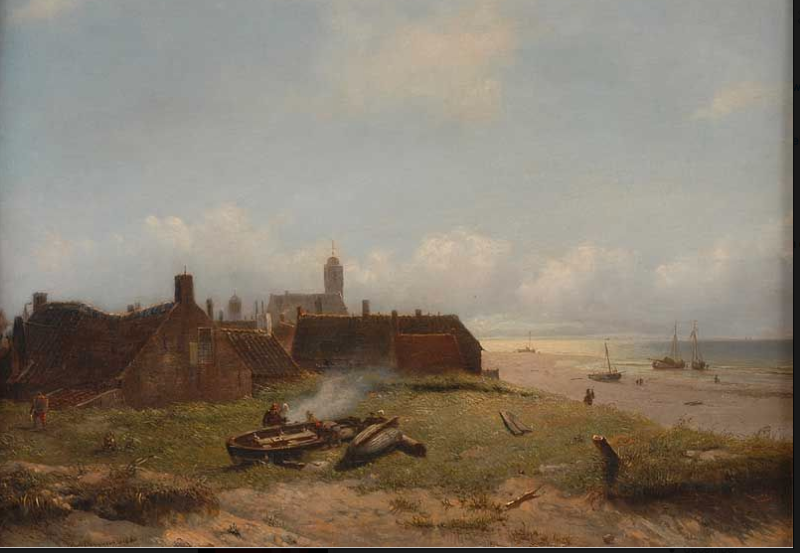
Katwijk in 1868
This is Katwijk in 1868, as seen from the dunes, through the eyes of Master Willem van Deventer.
The painting (37 x 50 cm) is for sale at Wendl in Rudolstadt. A similar work, but bigger, is on display in the Katwijk Museum, a loan from the Rijksmuseum. The Katwijk museum owns a fine collection of marine painting and is worth a visit, especially since the recent renovation and expansion. Closed on Sundays.
1/25/2013
Arthur Briët, the bath carriage
The year that the young Arthur Briët painted this work, 1888, was his last at the Antwerp art academy.
In the same year he won the first prize "consisting of two medals, one gold and one silver, besides books." In 1886, he had already won a considerable Dutch cash prize. After Antwerp he could therefore stay a while in Paris. But finally he arrived in Nunspeet, Netherlands, where he lived in a farmhouse, which he had rebuild in half authentic state, in order to use it as the setting for his interiors. This panel (10.5 x 15.5 cm) was for sale at Bonhams, Knightsbridge.
1/24/2013
The sensitive bomber: Thorn Prikker
Johan Thorn Prikker lived in Visee, Belgium for several years.
There he painted colorful abstract works, even before abstraction in painting was widely accepted. The Hague art establishment, united in Pulchri Studio, once the center of the Hague School didn't like it at all, found it a disgrace. And Prikker, who was not afraid of a verbal fight, wished his colleagues all the worst. "A nice little bomb" should be thrown into this "Pulchri junk, then they would wake up from their sleep, those chaps". But when writing this Thorn Prikker was not yet the famous applied arts professor in Germany. He uttered much of these youthful anarchist expressions in his correspondence with Henri Borel (published by Joosten), a correspondence that is amongst the nicest, and strangely enough also most sensitive art historical literature we have, including Vincents letters. This work was for sale at Christies.
1/22/2013
Pilot Cutter, Jan Maandag
The Vlisssingen 4 is a pilot cutter, on its way to a customer.
The painter of this watercolor (16 x 23 cm) is Jan Maandag, who painted it in the second half of the nineteenth century. The pilot cutters had to race, because whoever reached the ship first, got the job. They were very fast sailing ships, even at high seas. They had an ax shaped bow, and when they were eventually replaced by steam boats, sailing became a pastime for the rich and many pilot cutters were converted to racing boats.
1/21/2013
Joop Moesman for charity
It is not possible to write a boring book about the Utrecht surrealist J.H. Moesman, said the NRC in 1998 on the occasion of a Moesman exhibition in Arnhem.
"This contrarian artist, who earns a living with a completely stupid job in the Dutch Railways is an ideal target for a biographer. And not just because he is arguably the most important surrealist painter that the Netherlands have produced. "Willie" Moesman (1909 - 1988) was a passionate man who eagerly propagated his social and artistic conceptions. A troublemaker and fastidious seeker of controvesy who imposed strict conditions on the way in which his work should be exhibited. An environmental activist avant la lettre, who advocated the separation of garbage as early as the seventies. A grumpy pain-in-the-ass who was feared for his unbridled temper. And a man who made no secret of his sado-masochistic orientation." The work shown here was available at the Kiwanis art auction. That's a benefit auction that is held each year in Utrecht.
1/18/2013
Arie Zwart not fit for Tefaf
Art dealer Willem de Winter praised a painting by Arie Zwart in a populair Dutch art program.
Arie Zwart is a very good painter, who's fame is increasing, Winter said, and he was right. Yet art dealers like Winter wouldn't dare to display paintings by the artist on art shows like Pan or Tefaf. They know already in advance that these will not pass the jury. (It seems that an English Tefaf juror once tried to have all the paintings of Jan Sluijters removed, them being ... "Not of interest to the Tefaf public" ...) This painting (60 x 50 cm) was made by Zwart in Ibiza, where he repeatedly stayed. It was for sale at Derksen Auction Company in Arnhem.
1/15/2013
Toorop draws in the Zeeland dunes
In Zeeuws Veilinghuis, auctioneers in Middelburg, Netherlands, several drawings of Jan Toorop were on sale.
They sometimes fetch large to very large amounts, but it is an art in itself to know which ones are valuable and which are not. Much depends on date. Toorop just glued different pieces of paper together when a drawing did not fit, as can be seen from this company in the dunes. It was made in Zoutelande in 1903. One has to be accustomed with Toorop's oeuvre to appreciate these kinds of unpretentious works.
Subscribe to:
Posts (Atom)


